
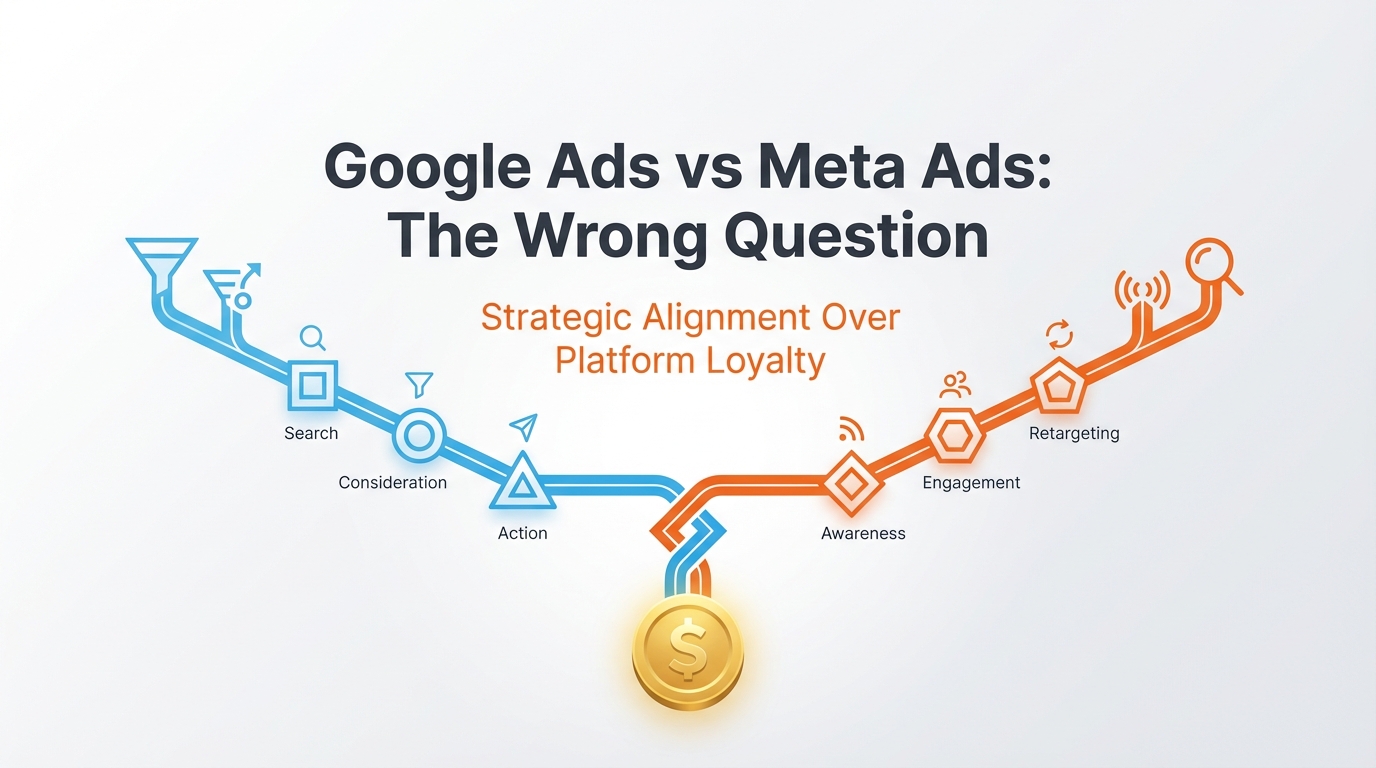
Google Ads vs Meta Ads: Which Works Better? (The Wrong Question)
Your marketing director just presented the quarterly paid
media report. Google Ads spent £12,400 generating 87 leads. Meta Ads spent
£9,800 generating 214 leads. The team declares Meta the winner more leads for
less spend.
Yet sales closed £68,200 from Google-sourced leads versus
£23,700 from Meta. Customer lifetime value from Google: £4,850. From Meta:
£1,120. The "winning" channel actually destroyed £18,300 in profit.
This isn't a platform failure. It's a strategic failure
disguised as data analysis.
The uncomfortable truth most agencies avoid: "Which
platform works better?" is the wrong question. Google and Meta serve
fundamentally different commercial purposes. Comparing them on lead volume
alone is like comparing a scalpel to a sledgehammer both are tools, but for
radically different jobs.
At Media Junkie, we've audited 203 paid acquisition
programmes over the past 24 months. The pattern is definitive: brands treating
Google and Meta as interchangeable channels show 63% lower blended ROAS
than those deploying each platform against its strategic strength. The
differentiator isn't platform selection it's commercial intent alignment.
This article dismantles the false dichotomy poisoning paid
strategy and rebuilds platform selection as what it should be: a deliberate
alignment between buyer journey stage, commercial intent, and acquisition
economics not a volume contest.
The False Dichotomy Trap: Why "Which Is
Better?" Destroys Value
Let's confront the foundational error poisoning platform
selection: treating Google and Meta as competitors rather than complementary
acquisition layers.
A B2B SaaS company allocates budget based on last quarter's
lead volume. Meta wins. They shift 80% of budget to Meta. Lead volume increases
47%. Sales-qualified lead volume decreases 38%. Why? Meta captured
top-funnel researchers; Google captured bottom-funnel buyers ready to purchase.
Volume without intent is noise.
Meanwhile, a competitor deploys Google for bottom-funnel
commercial intent ("CRM pricing," "project management software
comparison") and Meta for mid-funnel audience expansion (lookalikes of
closed customers, retargeting engaged blog readers). Result: 31% lower blended
CAC while increasing total pipeline 58%.
The data confirms the pattern. Brands optimising platforms
against identical KPIs (cost per lead) show 41% higher customer acquisition
costs than those optimising each platform against its strategic purpose
(Google for intent capture, Meta for audience expansion) (WordStream, 2026).
Why? Because you cannot optimise a scalpel and sledgehammer with the same
metrics.
Consider the e-commerce brand we audited last quarter:
declared Meta "superior" after generating 3.2x more leads at 40%
lower cost per lead. After 90 days, they discovered Google-sourced customers
had 3.7x higher lifetime value and 68% higher repeat purchase rates. They'd
optimised for lead volume while destroying customer quality.
This isn't platform failure. It's metric misalignment. When
you measure both channels against the same vanity metric, you optimise the
wrong behaviour.
Google Ads: The Commercial Intent Capture Engine
Google Ads doesn't sell ads. It sells access to commercial
intent.
When a user types "best CRM for small business
pricing" into Google, they've self-qualified as:
- Actively
researching solutions
- Comparing
vendors
- Ready
to evaluate pricing
- Within
14–45 days of purchase decision (B2B average)
This is bottom-funnel intent—the most valuable real
estate in digital marketing. Google Ads excels at capturing this intent
because:
- Intent
is explicit: Users declare commercial readiness through search queries
- Competition
is rational: Bids reflect commercial value (high commercial intent =
higher CPCs = better qualified traffic)
- Conversion
friction is minimal: Users expect to click and convert—no persuasion
required beyond relevance
Google's strategic sweet spot:
- B2B
services with considered purchases (£5K+ deal size)
- E-commerce
with high commercial intent keywords ("buy," "price,"
"review")
- Local
services with immediate need ("emergency plumber London")
- High-ticket
B2C with research phase ("best mattress for back pain")
Realistic 2026 performance benchmarks (B2B services):
|
Metric |
Strong
Performance |
Warning
Threshold |
|
Avg. CPC (commercial keywords) |
£4.20–£8.50 |
Below £2.50 (likely low intent) |
|
Cost per SQL |
£110–£180 |
Above £250 (conversion architecture issue) |
|
Lead-to-customer rate |
18–28% |
Below 10% (lead qualification failure) |
|
LTV of Google-sourced customer |
3.5–5.2x CAC |
Below 2.5x (intent mismatch) |
One cybersecurity client obsessed over "lowering
CPCs." They shifted budget to broad keywords ("cybersecurity
tips"). CPC dropped 63%. SQL volume dropped 71%. After refocusing
exclusively on commercial intent keywords ("SOC compliance audit
pricing"), CPC increased 47% but revenue per ad pound spent increased
340%.
Google rewards commercial intent not cheap clicks.
Meta Ads: The Audience Expansion and Trust Engineering
Platform
Meta Ads doesn't sell ads. It sells access to attention and
identity.
When a user scrolls Instagram or Facebook, they're not
declaring commercial intent. They're consuming content, connecting with
friends, killing time. Meta excels at:
- Audience
identification: Layering firmographics, behaviours, and lookalike
modelling to find prospects before they search
- Trust
engineering: Using social proof (client videos, UGC-style
testimonials) to compress consideration cycles
- Retargeting
depth: Re-engaging users across 7–14 touchpoints to build familiarity
before purchase
This is top-to-mid funnel influence valuable but
fundamentally different from Google's bottom-funnel capture.
Meta's strategic sweet spot:
- E-commerce
with visual products and impulse/low-consideration purchases
- B2C
services with emotional buying drivers (fitness, beauty, home services)
- B2B
audience expansion (lookalikes of closed customers, retargeting content
engagers)
- Brand
trust engineering for high-consideration purchases (before Google capture)
Realistic 2026 performance benchmarks (B2B services):
|
Metric |
Strong
Performance |
Warning
Threshold |
|
CPM (feed placement) |
£8–£14 |
Below £5 (likely bot traffic) |
|
Landing page view rate |
65–82% |
Below 50% (creative/landing mismatch) |
|
Cost per lead (top-funnel) |
£35–£65 |
Below £20 (likely unqualified) |
|
Lead-to-SQL rate |
8–15% |
Below 5% (audience mismatch) |
|
LTV of Meta-sourced customer |
2.1–3.4x CAC |
Below 1.8x (funnel misalignment) |
One B2B software client used Meta for bottom-funnel
"buy now" messaging. CTR looked strong. Lead quality was
catastrophic—92% were students and tire-kickers. After shifting Meta
exclusively to mid-funnel trust engineering (client case study videos,
implementation proof), lead volume decreased 37% but SQL rate increased 280%
and LTV:CAC improved from 1.4x to 4.1x.
Meta rewards trust engineering not direct response on cold
audiences.
The Strategic Alignment Framework: Matching Platform to
Business Model
The right platform isn't universal—it's dictated by your
business economics.
Framework 1: Buyer Journey Stage Alignment
|
Business
Scenario |
Primary
Platform |
Secondary
Platform |
Rationale |
|
High-consideration B2B (£10K+ deals, 60+ day sales
cycles) |
Google (bottom-funnel intent capture) |
Meta (audience expansion + retargeting) |
Capture commercial intent when ready; use Meta to build
awareness earlier in cycle |
|
E-commerce impulse (<£75 AOV, visual products) |
Meta (discovery + impulse conversion) |
Google (branded + high-intent non-branded) |
Meta drives discovery; Google captures existing demand |
|
E-commerce considered (£75–£300 AOV, research
phase) |
Meta (trust engineering) + Google (comparison intent) |
— |
Meta builds trust pre-search; Google captures comparison
phase |
|
Local services (immediate need, geographic
constraint) |
Google (hyperlocal commercial intent) |
Meta (geo-targeted awareness) |
Google captures urgent need; Meta builds local brand
recall |
Framework 2: Unit Economics Thresholds
Your customer lifetime value dictates platform viability:
- LTV
under £500: Meta often superior for e-commerce; Google rarely viable
for B2B (CAC exceeds LTV)
- LTV
£500–£2,500: Both platforms viable with strict funnel separation (Meta
top/mid, Google bottom)
- LTV
over £2,500: Google becomes primary acquisition channel; Meta for
audience expansion and retargeting
One home services company (LTV: £380) poured budget into
Google Ads chasing "plumber near me" keywords. Blended CAC: £412.
They switched exclusively to Meta hyperlocal awareness campaigns driving to
booking page. CAC dropped to £187. Profitability restored.
Another enterprise software company (LTV: £28,000) shifted
budget from Meta to Google after discovering 73% of closed deals had Google
touchpoints in final 14 days. Blended CAC decreased 31% while pipeline
increased 44%.
Platform selection must follow unit economics not industry
dogma.
The Integration Advantage: When Google + Meta Compound
Value
The highest-performing programmes treat Google and Meta as
integrated layers not competitors.
The Closed-Loop Acquisition Flywheel:
- Meta
identifies and warms audiences
- Lookalike
audiences built from closed-won customers
- Retargeting
users who consumed mid-funnel content
- Trust
engineering through client proof content
- Google
captures commercial intent
- Branded
search (users now aware of your solution)
- Competitor
conquesting ("vs" keywords)
- Solution-specific
commercial queries
- Cross-platform
attribution reveals true value
- Meta
assists 68% of Google-closed deals (Gartner, 2026)
- Google
captures 81% of deals assisted by Meta
- Blended
ROAS 2.3x higher than siloed optimisation
One B2B fintech client implemented this flywheel:
- Meta
ran case study video ads to lookalikes of closed customers
- Google
captured branded search + "alternative to [competitor]" queries
- Result:
47% lower blended CAC versus siloed platform optimisation
- Incremental
revenue: £283,000 annually from integration alone
The platforms aren't competitors. They're sequential
acquisition layers.
Common Strategic Failures (And How to Avoid Them)
Failure 1: Using identical messaging across platforms
→ Solution: Google ads = direct response (pricing, differentiators).
Meta ads = trust engineering (client proof, problem validation).
Failure 2: Optimising both platforms against cost per
lead
→ Solution: Google against cost per SQL. Meta against cost per
marketing-qualified engagement (content download, video view >75%).
Failure 3: Ignoring incrementality between platforms
→ Solution: Run geo-lift tests isolating each platform's true
incremental value. Most discover 30–50% of "Google conversions" were
assisted by prior Meta exposure.
Failure 4: Chasing low CPCs on Google
→ Solution: Higher CPCs on commercial intent keywords signal quality. If
CPC seems "too high," validate lead quality before optimising down.
Failure 5: Using Meta for cold direct response
→ Solution: Meta requires 3–7 touchpoints before conversion. Build
sequences: awareness → consideration → retargeting → conversion.
How to Select Your Platform Strategically (Actionable
Framework)
Stop asking "Which platform is better?" Start
asking "Which platform aligns with our buyer's commercial intent at each
journey stage?"
Step 1: Map Your Buyer's Search Behaviour (Week 1)
- Interview
5 recent customers: "What did you Google before contacting us?"
- Analyse
CRM data: Which search terms preceded closed deals?
- Identify
3–5 commercial intent keyword clusters representing bottom-funnel queries
Step 2: Calculate Platform Viability Thresholds (Week 1)
- Google
minimum viable LTV: 4x target CPA (e.g., £150 CPA requires £600+ LTV)
- Meta
minimum viable LTV: 3x target CPA (e.g., £80 CPA requires £240+ LTV)
- If
your LTV falls below these thresholds, neither platform may be
viable—reconsider business model first
Step 3: Design Funnel-Aligned Platform Roles (Week 2)
- Google:
Bottom-funnel intent capture only (no brand awareness campaigns)
- Meta:
Top/mid-funnel audience expansion + retargeting only (no cold direct
response)
- Document
specific KPIs for each platform (not shared metrics)
Step 4: Implement Cross-Platform Attribution (Week 3)
- Configure
position-based attribution (first + last touch weighted equally)
- Tag
campaigns to isolate platform influence at each funnel stage
- Measure:
Google's capture rate of Meta-assisted users
Step 5: Establish Performance Guardrails (Ongoing)
- Google:
Pause keywords with <15% SQL rate regardless of CPC
- Meta:
Pause audiences with <8% lead-to-SQL rate regardless of lead volume
- Quarterly
incrementality testing to validate true platform contribution
Stop optimising platforms in isolation. Start engineering
acquisition sequences.
Why Most Paid Agencies Get This Wrong
Let's be direct: Most paid agencies profit from platform
activity not revenue outcomes.
- Google
Ads specialists sell "lower CPCs" while ignoring lead
quality collapse
- Meta
Ads shops sell "cheap leads" while obscuring catastrophic
LTV:CAC ratios
- Full-funnel
agencies bundle platforms without strategic separation optimising the
average while destroying each platform's strength
- Platform-certified
vendors push platform-native strategies that maximise platform revenue
not your profitability
At Media Junkie, we operate differently. We assess your
buyer journey before selecting platforms. We align each platform to its
strategic strength not arbitrary budget splits. We measure blended LTV:CAC
across the acquisition sequence not siloed platform metrics. We report what
matters: incremental profit per ad pound spent not CPCs or lead volume.
We don't sell Google or Meta management. We engineer
profitable acquisition sequences across platforms.
Conclusion: Intent Over Platform Loyalty
Google Ads captures commercial intent. Meta Ads engineers
trust and expands audiences. Neither is universally "better" both are
essential when deployed against their strategic strength.
The businesses winning paid acquisition aren't the ones
loyal to a single platform—they're the ones ruthlessly aligning each platform
to specific buyer journey stages. They treat Google as their intent capture
engine and Meta as their audience expansion layer. They measure blended
outcomes—not platform silos.
Stop asking "Which platform should we use?" Start
asking "How do we engineer a sequential acquisition sequence where Meta
builds awareness and Google captures intent measured by blended
profitability?"
The platforms will foll and this time, they'll actually
generate profit.
Ready for Paid Acquisition That Generates Profit Not Just
Leads?
If your current paid strategy treats Google and Meta as
competitors or measures both against identical vanity metrics it's time for
strategic recalibration.
Media Junkie engineers’ revenue-driven paid acquisition
sequences that generate margin-positive customers across platforms—not siloed
activity reports.
Book a Free Paid Acquisition Profitability Audit
We'll analyse your current Google and Meta programmes through a unit economics
lens and deliver a clear roadmap showing exactly how much incremental profit
your paid channels should be generating and why they aren't.
No CPC reports. No lead volume celebrations. Just a
commercial assessment of your paid acquisition's profitability potential and
how to unlock it.