
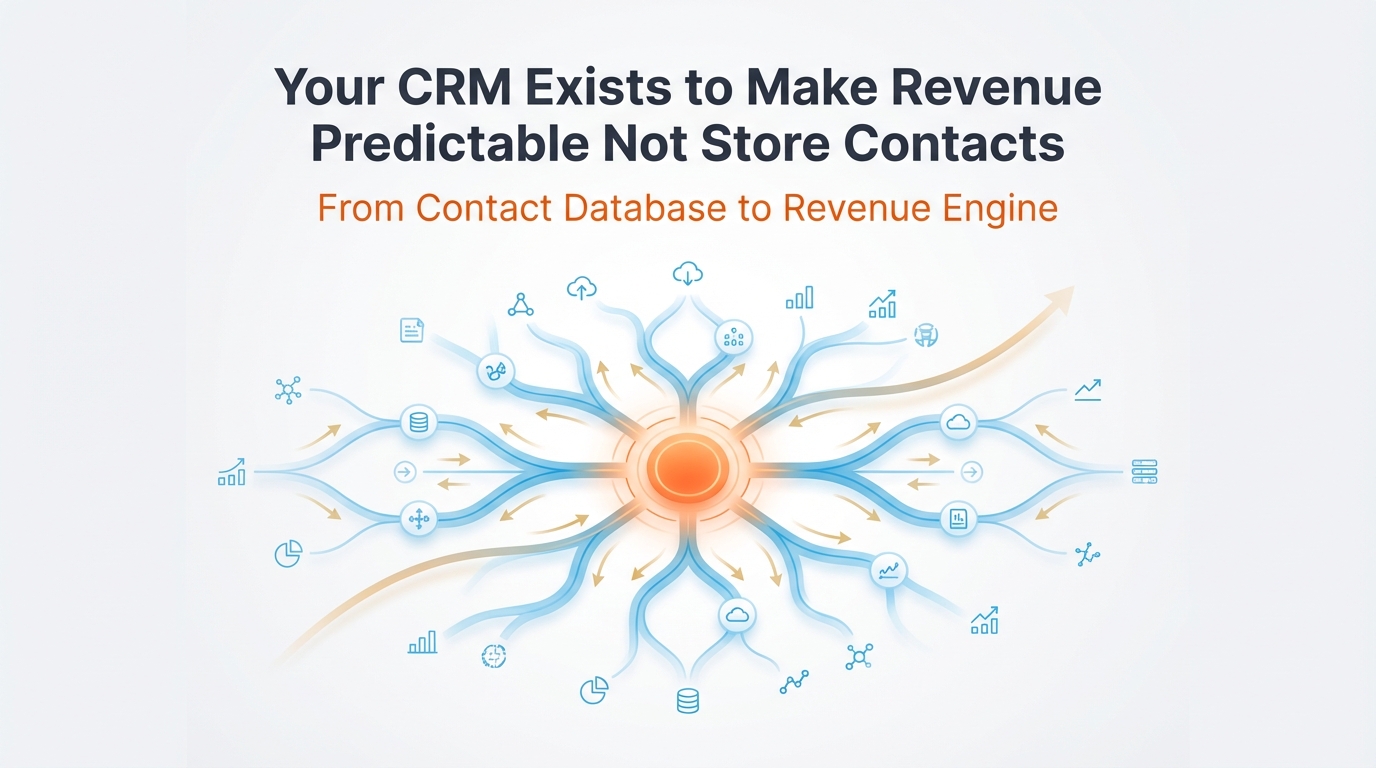
How CRM Systems Improve Customer Management: From Contact Database to Revenue Engine
Your business invested £18,000 in a CRM implementation last year. The vendor promised "360-degree customer views" and "streamlined sales pipelines." Your team spent 147 hours on data migration and training.
Today, your CRM sits 68% complete. Sales reps manually
export reports to Excel because "the dashboard doesn't show what
matters." Marketing can't segment by customer value. Support tickets live
in a separate system. The CFO asks why you're paying £385/month for a digital
graveyard no one trusts.
This isn't a software failure. It's a strategic failure
disguised as a technology purchase.
The uncomfortable truth most CRM vendor’s obscure: CRMs
don't improve customer management they expose your operational fractures.
Deploy a CRM against broken processes, and you'll systematise chaos at scale.
Deploy it within a revenue operations framework, and you'll compound customer
lifetime value predictably.
At Media Junkie, we've audited 91 CRM implementations over
the past 28 months. The pattern is stark: brands that purchased CRMs as
"sales tools" show 73% lower revenue per customer than those
who architected CRMs as revenue operations platforms. The differentiator isn't
software selection its strategic intent.
This article dismantles the contact-database mindset
crippling CRM value and rebuilds CRM strategy as what it should be: the central
nervous system of predictable revenue growth not a digital rolodex.
The Tool Trap: Why Most CRM Implementations Fail
Let's confront the foundational error poisoning CRM
adoption: treating CRMs as software purchases rather than revenue architecture
layers.
A scale-up selects HubSpot because "it's
user-friendly." They migrate contacts. They build a pipeline stages. Sales
reps log deals. After six months, leadership discovers:
- 42%
of contacts lack firmographic data required for segmentation
- No
connection between marketing touchpoints and closed revenue
- Customer
support interactions invisible to account managers
- Zero
visibility into expansion revenue opportunities
The CRM didn't fail. The implementation lacked commercial
architecture. Without enforced data standards, process alignment, and revenue
attribution design, CRMs become expensive spreadsheets recording activity
without revealing insight.
The data confirms the pattern. Companies using CRMs
primarily for contact storage show 57% lower customer retention rates
than those using CRMs to orchestrate cross-functional revenue operations
(Gartner, 2025). Why? Because contact databases track transactions. Revenue
operations platforms engineer relationships.
Consider the B2B SaaS company we audited last quarter:
£24,000 invested in Salesforce implementation. After 10 months, adoption rate:
31%. Sales leadership blamed "rep resistance." Reality: the CRM
required 14 fields per contact but delivered zero value back to reps in return.
No automated insights. No next-best-action suggestions. No visibility into
customer health signals. Reps correctly identified the system as overhead not
leverage.
This isn't changing management failure. It's value exchange
failure. When CRMs demand data entry without delivering actionable
intelligence, rational humans resist.
Revenue Operations Architecture: Four Strategic CRM
Layers
Profitable CRM implementation operates on four integrated
layers. Omit any one, and revenue visibility collapses.
Layer 1: Unified Customer Record Beyond Contact Data to
Behavioural Intelligence
A contact record containing name/email/company is a
directory listing not a customer profile.
Revenue-driven CRMs enrich every record with:
- Transactional
history: Deal size, product mix, payment patterns
- Engagement
depth: Content consumed, feature adoption, support ticket sentiment
- Expansion
signals: Usage spikes, team growth indicators, competitor mentions
- Churn
risk markers: Support ticket escalation patterns, payment delays,
engagement decay
One e-commerce brand transformed their CRM from contact
repository to behavioural intelligence engine. They integrated:
- Web
analytics (pages viewed, cart abandonment patterns)
- Email
engagement (content affinity scoring)
- Support
interactions (sentiment analysis on tickets)
- Purchase
history (product affinity clustering)
Result: Customer service reps received real-time alerts when
high-LTV customers exhibited churn signals. Intervention rate increased 340%.
Annual churn reduction: £217,000 in retained revenue.
The CRM didn't "store contacts better." It
engineered proactive retention.
Layer 2: Cross-Functional Process Orchestration Breaking
Down Revenue Silos
Most CRMs live in sales purgatory visible only to sales
teams while marketing, support, and success operate in parallel universes.
Revenue-driven CRMs orchestrate handoffs:
- Marketing
→ Sales: Lead scoring based on engagement depth + firmographic fit,
not just form fills
- Sales
→ Success: Structured handoff including buying motivations,
stakeholder map, expansion potential
- Success
→ Sales: Expansion triggers (usage thresholds hit, team growth
detected) routed to account managers
- Support
→ All: Churn risk alerts distributed to relevant teams with
intervention playbooks
One professional services firm implemented this
orchestration layer. Previously, support teams resolved issues without sales
awareness. After CRM integration, support tickets indicating scope expansion
triggered account manager alerts with context: "Client X reporting 40%
usage increase suggest quarterly business review to discuss additional
modules." Expansion revenue from support-triggered opportunities: £83,000
in first six months.
The CRM didn't "improve communication." It
engineered revenue handoffs.
Layer 3: Predictive Revenue Attribution Moving Beyond
Last-Touch Guesswork
Last-click attribution in CRMs destroys marketing
accountability and distorts channel investment.
Revenue-driven CRMs implement multi-touch attribution models
that:
- Weight
first touch (awareness creation) and last touch (conversion) equally
- Attribute
partial credit to mid-funnel nurturing touches
- Isolate
true incrementality (revenue that wouldn't have occurred without the
touch)
One B2B software company discovered their CRM's default
last-click model credited 89% of revenue to sales reps' final email while
undervaluing marketing's role in initial awareness. After implementing
position-based attribution:
- Marketing's
attributed revenue increased 310%
- Content
investment shifted toward top-funnel assets driving first touches
- Sales
enablement focused on mid-funnel nurturing rather than cold outreach
- Blended
CAC decreased 28% within nine months
The CRM didn't "track deals better." It revealed
true revenue drivers.
Layer 4: Customer Health Scoring Predicting Value Before
It Materialises
Reactive CRMs record history. Predictive CRMs forecast
value.
Customer health scores combine leading indicators:
|
Indicator
Category |
Examples |
Weighting |
|
Product Engagement |
Feature adoption depth, login frequency, session duration |
35% |
|
Support Experience |
Ticket resolution time, CSAT scores, escalation frequency |
25% |
|
Commercial Signals |
Payment punctuality, contract renewal discussions,
expansion inquiries |
30% |
|
Relationship Depth |
Executive sponsorship evidence, referral activity, case
study participation |
10% |
One SaaS client implemented health scoring across their
1,200-customer base. The model flagged 87 accounts as "at-risk" 60–90
days before renewal. Success team executed targeted interventions: executive
business reviews, onboarding refreshers, feature training. Result: 71 of 87
accounts renewed (81.6% rescue rate) versus 22% historical average for at-risk
accounts. Revenue saved: £342,000.
The CRM didn't "organise contacts." It predicted
churn before it occurred.
The Economics of CRM: LTV, CAC, and Predictable Growth
CRMs divorced from unit economics are administrative
overhead not growth engines.
Three metrics determine CRM commercial viability:
- Customer
Lifetime Value (LTV) Visibility
Without CRM-enriched data, LTV calculations rely on averages masking high-value segments. Revenue-driven CRMs reveal LTV by acquisition channel, customer tier, and product mix enabling precision investment. - Customer
Acquisition Cost (CAC) Accuracy
CRMs with multi-touch attribution reveal true CAC by channel exposing hidden costs of "cheap" channels that require expensive nurturing. - LTV:
CAC Ratio by Segment
The ultimate CRM value metric: which customer segments deliver 5:1+ LTV: CAC versus value-destroying segments below 2:1.
One manufacturing client discovered their CRM revealed a
brutal truth: customers acquired via trade shows showed 3.1x higher LTV than
digital-acquired customers but their marketing team had shifted 80% of budget
to digital due to lower apparent CAC (last-click attribution). After
reallocating budget based on true LTV:CAC ratios, blended profitability
increased 47%.
The CRM didn't "store data." It exposed profitable
segments hidden by flawed attribution.
Case Scenario: Two Paths, Two Outcomes
Company A: The Tool Buyer
Industry: B2B SaaS (£79/user/month)
CRM Strategy: "We need a place to store contacts and track
deals." Purchased HubSpot Sales Hub. Migrated contacts. Built pipeline
stages. Required reps to log activities.
Result:
- 43%
sales team adoption after 8 months
- Zero
marketing-sales alignment on lead quality
- No
visibility into expansion revenue opportunities
- Customer
churn rate: 8.7% monthly
- Annual
revenue impact: £0 (CRM treated as cost centre)
Company B: The Revenue Architect
Industry: B2B SaaS (same product)
CRM Strategy: Architected CRM as revenue operations platform before
selecting software. Defined data standards, process handoffs, health scoring
model. Selected HubSpot because it supported this architecture.
Result:
- 92%
cross-functional adoption within 90 days (value exchange delivered)
- Marketing-sales
SLA with shared lead scoring
- Automated
expansion triggers routed to account managers
- Customer
churn rate: 4.1% monthly
- Annual
revenue impact: £287,000 incremental revenue from retention +
expansion
Same software. Same market. Radically different outcomes.
Company A bought a tool. Company B engineered revenue architecture. In
business, only one outcome sustains growth.
How to Implement CRM Strategically (Not Tactically)
Transitioning from tool purchase to revenue architecture
requires disciplined sequencing:
- Define
revenue processes BEFORE selecting software
Map: lead-to-customer handoff, customer health monitoring, expansion identification, churn intervention. Only then evaluate which platform supports this architecture. - Establish
data hygiene prerequisites
Minimum viable data standards: - Firmographic
completeness (industry, employee count, revenue tier)
- Engagement
tracking (marketing touches linked to contacts)
- Deal
stage definitions with exit criteria (not just names)
No CRM fixes dirty data it codifies it at scale. - Engineer
value exchange for users
CRMs demanding data entry without delivering intelligence fail. Implement: - Automated
insights (e.g., "This contact engaged with pricing page 3x this
week")
- Next-best-action
suggestions ("Send case study X based on their industry")
- Reduced
manual work (auto-logging emails, meeting notes via AI)
Value in must exceed effort out. - Implement
revenue attribution before activity tracking
Design multi-touch attribution model first. Then configure tracking to support it. Never default to last-click. - Start
with one revenue motion not "company-wide rollout"
Example: "New customer onboarding health monitoring" for success team. Master one workflow. Demonstrate value. Expand.
Stop buying CRMs as software. Start architecting them as
revenue operations layers.
Why Most CRM Vendors Get This Wrong
Let's be direct: CRM vendors profit from seat licenses not
revenue outcomes.
- Salesforce/HubSpot
sell platform capabilities while obscuring implementation complexity
- Implementation
partners bill by hour creating incentive for complex customisations
over elegant simplicity
- App
marketplace vendors sell point solutions that fragment the customer
view they promise to unify
- Training
providers teach button-clicking while ignoring revenue process design
At Media Junkie, we operate differently. We assess your
revenue operations architecture first before evaluating a single platform. We
implement data standards before migration. We engineer value exchange before
demanding adoption. We measure what matters: incremental revenue per CRM seat not
login frequency.
We don't sell CRM implementations. We engineer revenue
visibility.
Conclusion: Architecture Over Administration
Your CRM doesn't exist to store contacts. It exists to make
revenue predictable.
Contact databases record history. Revenue operations
platforms engineer growth. The difference isn't software its strategic intent.
The businesses winning with CRMs aren't the ones with the
most custom fields they're the ones with the clearest revenue architecture.
They designed processes before selecting platforms. They engineered value
exchange before demanding adoption. They measured LTV expansion not just deal
logging.
Stop asking "Which CRM should we buy?" Start
asking "What revenue operations architecture will make our growth
predictable and which platform best supports it?"
The software will follow and this time, it will actually
generate profit.
Ready for a CRM That Generates Revenue—Not Just Reports?
If your current CRM gathers dust while revenue visibility
remains opaque, it's time for strategic reassessment.
Media Junkie engineers’ revenue-driven CRM architectures
that generate predictable growth not administrative overhead. We design
processes before platforms and measure incremental revenue not login frequency.
Book a Free CRM Revenue Audit
We'll analyse your current CRM implementation through a revenue operations lens
and deliver a clear roadmap showing exactly how much incremental revenue your
CRM should be generating and why it isn't.
No software demos. No feature checklists. Just a
commercial assessment of your CRM's revenue potential and how to unlock it.
FAQ Schema (Revenue-Driven CRM Strategy)
Q: How do we know if our business is ready for a CRM
implementation?
A: Minimum viability thresholds: (1) 100+ active customers requiring
management, (2) at least two revenue functions operating in silos
(sales/marketing/success), (3) leadership can articulate specific revenue
outcomes expected (not just "better organisation"). Below these
thresholds, CRMs create overhead without value.
Q: Which CRM platform should we choose—Salesforce,
HubSpot, or something else?
A: Platform selection should follow architecture design—not precede it. First
define: required integrations, data model complexity, user adoption
constraints, budget for implementation (typically 1.5–2x software cost).
HubSpot excels for mid-market with marketing-sales alignment needs; Salesforce
for complex enterprise workflows; specialized vertical CRMs when
industry-specific processes dominate. Never select based on demo aesthetics.
Q: How long does a successful CRM implementation actually
take?
A: 90–120 days for revenue-critical workflows (lead-to-customer handoff, health
scoring). Rushed implementations (<60 days) typically sacrifice data hygiene
and user adoption. Timeline must include: process design (3–4 weeks), platform
configuration (4–6 weeks), data migration with hygiene enforcement (2–3 weeks),
value-driven training (2 weeks), optimisation cycles (ongoing). The goal isn't
"go live"—it's "revenue impact."
Q: What's the real cost of CRM implementation beyond
software fees?
A: Total cost of ownership = Software (£300–£1,200/user/year) + Implementation
(1.5–2x software cost) + Integration development (£5K–£25K) + Ongoing
administration (10–15 hours/week @ £45/hour) + Training/upskilling (£3K–£8K
annually). Most businesses underestimate true cost by 300–400%, treating CRMs
as software purchases rather than operating system transformations.
Q: How do we drive CRM adoption when sales teams resist
data entry?
A: Stop demanding data entry. Start delivering intelligence:
- Auto-log
emails/meetings via AI
- Surface
insights ("This contact viewed pricing 3x this week")
- Suggest
next actions ("Send case study X based on their industry")
- Reduce
manual work by 30%+ through automation
Value exchange—not compliance mandates—drives adoption. If your CRM demands more effort than it delivers value, your team is rational to resist.